









Three-dimensional design has long remained the domain of trained professionals equipped with expensive software and years of technical training. Today, artificial intelligence is fundamentally transforming this landscape, enabling anyone from hobbyists to established creators to produce publication-ready 3D models within minutes instead of hours. AI-powered 3D design platforms bridge the gap between imagination and execution, removing technical barriers while maintaining professional-grade output quality that rivals traditionally trained modelers.
Breaking Down the Barrier to Entry
Traditional 3D modeling requires mastery of complex software interfaces, understanding of polygon topology, UV mapping, texture application and rendering techniques. Learning these skills demands months of dedicated study and practice. AI-driven solutions eliminate these prerequisites by accepting simple text descriptions or 2D images as input, then autonomously generating complete 3D models that are immediately usable. A designer can describe “a Victorian armchair upholstered in teal velvet” and receive a fully textured, ready-to-render model. This Meshy democratization means graphic designers, marketers, game developers and architects can now produce 3D assets without outsourcing to specialized studios or spending thousands on software licenses. The learning curve flattens dramatically when AI handles the technical complexity beneath user-friendly interfaces.
Accelerating Workflow from Concept to Completion
Professional 3D workflows typically involve multiple stages concept sketching, modeling, retopology, UV unwrapping, texturing, rigging and rendering. Each stage introduces opportunities for iteration and revision, extending timelines significantly. AI acceleration compresses this pipeline by automating intermediate steps that previously consumed hours per asset. An architect visualizing a residential interior can generate dozens of furniture piece variations in the time previously required to model a single chair. Meshy game developers prototyping environments can iterate rapidly without waiting for asset pipelines. Product designers can explore styling options visually before committing to physical prototypes. This speed advantage transforms how teams operate, enabling more ambitious creative vision with finite resources.
Maintaining Quality While Scaling Production
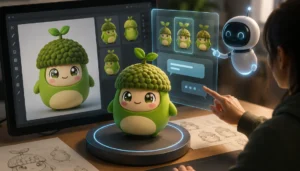
Speed shouldn’t compromise quality, yet traditional modeling requires skilled hands to maintain consistency across dozens of assets. AI systems trained on massive datasets of professional 3D models internalize quality standards automatically. Generated models arrive with proper geometry, sensible topology and realistic proportions without manual intervention. Texture generation uses photorealistic training data to produce surfaces that catch light naturally. This means junior team members produce work at senior-quality levels and scaling asset creation doesn’t mean diluting visual polish. Teams can focus creative energy on unique, high-value assets while AI handles the volume work that maintains environmental cohesion and visual consistency.
Key Benefits of AI-Powered 3D Creation
These platforms deliver measurable advantages across creative disciplines
- Text-to-3D generation transforms written descriptions directly into complete, textured models ready for immediate use.
- Reduced production costs by replacing expensive freelancers and licensing fees with affordable subscription access.
- Faster iteration enabling designers to explore dozens of variations before settling on final concepts.
- Consistent quality across multiple assets maintained automatically through AI training on professional models.
- Integration with industry software allows seamless incorporation into existing Blender, Maya and Cinema 4D workflows.
Versatility Across Industry Applications
AI 3D creation transcends single use cases. E-commerce platforms use AI-generated product models to showcase goods from multiple angles without expensive photography sessions. Game studios populate entire environments with AI-assisted assets, reducing crunch periods and allowing smaller teams to achieve AAA-level visual complexity. Architects generate photorealistic renderings of designs before construction begins. Product designers rapidly prototype and iterate visual concepts. Educational institutions create anatomically accurate teaching models. Jewelry designers craft intricate pieces that can be 3D printed directly. VR/metaverse developers build immersive spaces at scale. This Meshy versatility means different teams using the same underlying AI technology achieve vastly different creative outcomes based on their domain expertise.
Customization and Professional Integration

AI-generated models serve as excellent starting points and professional workflows typically involve refinement. Artists import AI models into traditional 3D software for customization, detailing and stylization. This hybrid approach combines AI speed with human creativity, the machine handles foundational geometry quickly while skilled artists concentrate on distinctive elements that differentiate final output. Meshy’s AI-powered 3D tools support this workflow, generating models that import directly into industry-standard software like Blender, Maya and Cinema 4D. The models arrive with clean topology suitable for rigging, modification and rendering. This integration with existing pipelines means teams adopt AI assistance without abandoning proven workflows or retraining staff on entirely new systems. Cost implications remain dramatic, outsourcing 3D assets to professional studios costs hundreds to thousands of dollars per model, while in-house modeling requires hiring specialized talent commanding premium salaries. Using Meshy’s AI 3D platform transforms economics for independent game developers, animators and designers who previously operated under constrained budgets.
Future Evolution and Industry Transformation
Current AI 3D platforms represent early implementations of this technology. As training datasets expand and algorithms improve, output quality will approach indistinguishability from hand-modeled work. Integration with other AI systems, generative text-to-image, animation prediction, material simulation, will create seamless pipelines where a single textual description generates entire animated sequences with sound design. Real-time generation means adjusting designs interactively based on feedback. The creative landscape will shift from tool mastery toward idea clarity, the best designers will be those who articulate vision most effectively, not those with deepest software knowledge. This trajectory points toward design tools so intuitive and powerful that technical expertise becomes optional rather than prerequisite. Meshy Start exploring what AI 3D creation enables for your projects today, positioning yourself ahead of this transformation. Whether you’re a seasoned 3D artist evaluating productivity improvements or an artist from adjacent disciplines considering 3D for the first time, Meshy’s AI tools democratize professional 3D production. The barrier between imagination and 3D model has never been lower. Take advantage of this shift by exploring what’s possible when AI handles technical complexity, discover Meshy’s capabilities and transform how you create visual assets.